 KES
 USD - International

It is the first question anyone sensible asks. A cPanel licence costs several times more direct than it does from a shared-licence provider, and a price difference that large usually means something is wrong.
Here is what is actually going on, including the parts that should make you careful.
What a shared license is
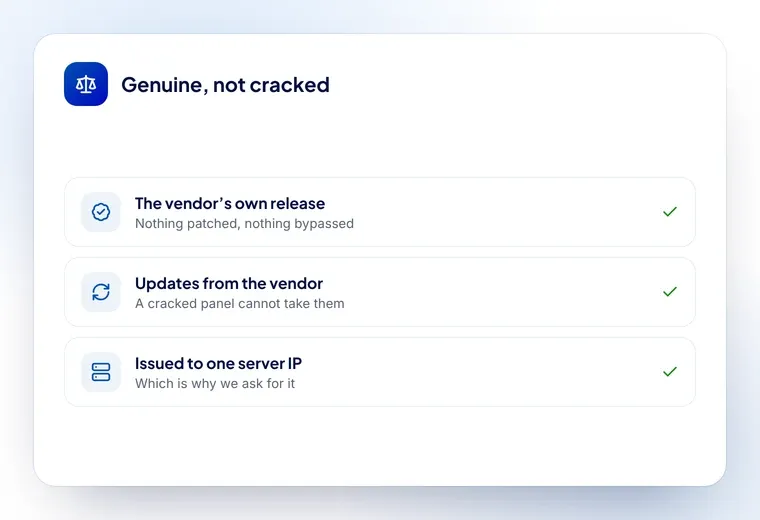
Licences are bought in volume and issued to individual servers. You install the vendor’s own software, your server validates its licence, and the product behaves exactly as a directly bought copy does.
Nothing is cracked. No files are patched, no checks are bypassed, no modified binaries are involved. If they were, the giveaway would be immediate: a cracked panel cannot take updates from the vendor, because the vendor’s update server would refuse it. A shared licence updates normally, which is only possible because the licence is real.
How to tell a genuine one from a nulled one
Four tests, and they are easy to run:
- Does it update? Run the panel’s own update command. A genuine licence pulls from the vendor’s repository. A nulled copy breaks, or silently never updates
- Does the licence verify? cPanel, LiteSpeed and the rest all have a licence-check page that queries the vendor. A genuine licence shows as valid there
- Where do the files come from? A genuine install downloads from the vendor’s own servers. If a provider sends you a tarball or asks you to run a script from somewhere else, stop
- Does the provider ask for your server IP? They must. A licence is issued against one address, so a seller who does not ask for it is not issuing you a licence
A provider who wants to install their own monitoring agent on your server, or who cannot explain where the software comes from, is selling you something else.
What is genuinely different from buying direct
Being straight about it:
- Your relationship is with us, not the vendor. Support for the licence comes from us. Support for the software is the vendor’s documentation and community, the same as anyone’s
- One licence, one IP. Moving servers means telling us so the licence moves too
- It is not a perpetual licence. It renews monthly or yearly, and it stops working if you stop paying — the same as a direct subscription
None of that is hidden, and none of it is unusual. It is how per-server software has been sold for years.
Who shared licensing is for
Resellers, agencies, developers and small hosts running a handful of servers — the people for whom the panel bill is a real proportion of the business. Shared licensing exists because the price rises of the past few years pushed exactly those businesses to the edge.
If you are a large host running hundreds of servers, buy direct and negotiate. If you are running one or two, the arithmetic is different and this is why.
What to check before you pay anyone
- Ask what happens when you change IP. A straight answer means a real licensing operation
- Ask whether updates come from the vendor. The answer should be yes, without qualification
- Check you are not asked to install anything unusual beyond the vendor’s own software
- Check you can cancel. Monthly, no minimum term, no setup fee
Our own answers to all four are on the shared licenses page, and if you would rather ask a person than read a page, our team is on live chat around the clock.